Sunday, 24 February 2013

Apple Product Life Cycles

Apple Product Life Cycles, the iPad, the iPhone and the iPad

Apple Product Life CyclesThe markets may have been disappointed with iPad sales in the final quarter of the year as sales fell back to 14 million units from the 17 million recorded in the third quarter but is this such a disappointment? For the year as a whole sales increased by 80% from 32.4 million to 58.3 million units.
The iPad has achieved cumulative sales of just under 100 million units in the first three years since launch. Compare this with the iPod with sales of just under 6 million in the first 1000 days and the iPhone’s 34 million units over a similar period, a quarter sales slow down is a minor setback. The launch of the iPad has been remarkable despite supply side constraints.

Interested in apple from the ipod to ipad then view the folliwng casestudy:
Apple Corporate Strategy Case Study


Friday, 22 February 2013

Apple Smart Watch


Apple patentApple describes a device which wraps itself around the user's wrist

Apple smart watch efforts confirmed by US patent


Fresh evidence that Apple has been working on a smart watch concept since at least 2011 has emerged in a patent filing.
The document describes a flexible touchscreen display which would communicate with a smartphone or other electronic device.
It coincides with a report from a tech consultancy suggesting there is huge pent up demand for such a gadget.
But ABI Research warns that battery life issues still need to be addressed.
It says assuming such problems can be resolved, about 485 million wearable computing devices might ship by 2018, providing a significant growth opportunity for Apple and the wider consumer electronics industry.
Not all published patents lead to actual products, but Bloomberg, the Wall Street Journal and the New York Times have all published reports this month saying sources had confirmed Apple was experimenting with a watch-like device.

The Boston Consulting Group Matrix/ Product Portfolio Management


The famous BCG matrix classifies a firm’s product portfolio into four strategic business units (SBU): Stars, Question Marks, Cash Cows and Dogs.  Within each SBU, there are again four potential strategies to take: build market share, hold market share, harvest (reduce investment) and divest (phase-out).
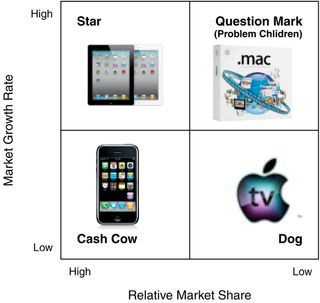
Star:  This would be the iPad because it has a high share of the rapidly growing tablet market.  As the iPad is in its growth phase of the product life-cycle, the product is beginning to lose its first-mover advantage as other manufacturers begin to launch theirown tablet devices.  Hence, Apple should invest heavily into marketing the iPad in order to grow sales to maintain their share (sales need to grow at the same rate as overall market sales to maintain market share within a growing market).  But in the future, when market sales become stable, Apple should harvest the product to turn it into a Cash Cow to fund other SBUs.
Question mark: Despite Apple’s best attempts, PCs with Microsoft operating systems still continue to dominate the PC market.  Much of this is down to strong business-to-business marketing and high switching costs for businesses and consumers, alike.  Apple could potentially used three strategies for their Mac software:
1) Divest – this could allow Apple to devote more time on their most profitable products, but it is highly unlikely as the Mac is part of the firm’s brand identity.
2) Build – Apple could potentially invest lots and lots of resources to try to turn Macs into a star, however even with Apple’s huge cash pile, it is questionable if it is even possible to beat Microsoft-powered PCs.
3) Hold – this is the most likely strategy.  Apple will probably continue to develop new Macs and support existing customers, however investments will be kept at a minimum and be target towards the iPad.
Cash Cow: Apple’s source of steady flows of income are clearly the iPhone and the iPod; both the MP3 and mobile phone market have reached saturation and Apple has a high share of both these markets.
As the iPod is reaching the decline stage of the PLC, Apple is beginning to harvest the product.  That is, slowly reducing investment in marketing iPods to increase their profitability; by generating more cash, further investments can be made into question marks or stars.
In the future, Apple will probably only maintain their market share of the iPhone. It is a highly profitable to generate sales from existing customers from upgrades, which can be almost guaranteed after a consumer invests heavily in downloads from the app store.
Dog: Lastly, Apple TV – a device that allows media files in iTunes to be played on a TV – has never really caught-on.  By launching a second and third generation, Apple have shown they are committed to building sales.  However, unless the overall market for digital media receiver grows, it could be more profitable to divest the product.

Sony Playstation Launch


Full Article on the timeline of Sony Playstation 1-4


The history of the device is worth revisiting. PlayStation was launched in 1994, a fringe product created by renegade engineer Ken Kutaragi. His vision, he once told me, “was to create a new concept for computer entertainment — we wanted to include as much of the audience as possible, including females and seniors, East and West, North and South…. In our minds it was not a game machine, but a preparation for future entertainment.”
PlayStation 1 became a surprise hit, eventually selling 100 million, but the real game changer was PlayStation 2, released in 2000. That second iteration pushed the technology envelope with better graphics and faster chips than you’d find in a PC. It was also the first game machine with optical DVD storage. But Kutaragi’s larger vision was remaking and broadening entertainment. “Content itself is culture,” he said as he prepared to launch. That was part of the reason that he felt it imperative for new iterations of PlayStation to run previous software. “A new version PlayStation should create new forms of entertainment,” he said, but “we don’t want to throw away our history, it’s very, very clear that keeping compatibility is important.”

Product Portfolio Analysis

Simple explanation of Product life Cycle and Boston Matrix.  Slightly annoying accent and tonality but content is relevant.

Product Life Cycle


Product - the Product Life Cycle


Marketing - Product life cycles
The product life cycle is an important concept in marketing.  It describes the stages a product goes through from when it was first thought of until it finally is removed from the market. Not all products reach this final stage.  Some continue to grow and others rise and fall. 
Product life cycle
The main stages of the product life cycle are:
  • Introduction – researching, developing and then launching the product
  • Growth – when sales are increasing at their fastest rate
  • Maturity – sales are near their highest, but the rate of growth is slowing down, e.g. new competitors in market or saturation
  • Decline – final stage of the cycle, when sales begin to fall
This can be illustrated by looking at the sales during the time period of the product.

A branded good can enjoy continuous growth, such as Microsoft, because the product is being constantly improved and advertised, and maintains a strong brand loyalty.
Extension strategies extend the life of the product before it goes into decline.  Again businesses use marketing techniques to improve sales.  Examples of the techniques are:
  • Advertising – try to gain a new audience or remind the current audience
  • Price reduction – more attractive to customers
  • Adding value – add new features to the current product, e.g. video messaging on mobile phones
  • Explore new markets – try selling abroad
  • New packaging – brightening up old packaging, or subtle changes such as putting crisps in foil packets or Seventies music compilations

Source:www.tutor2u.net

Saturday, 16 February 2013

New Apple products for 2013

future Apple products 2013
Apple is constantly trying to push the envelope with its clear design, innovative technology solutions and strategic product launches. Here are a few future Apple products 2013 that the company could develop in the near future.

Malcolm Gladwell and Spaghetti Sauce

 
http://www.ted.com Tipping Point author Malcolm Gladwell gets inside the food industry's pursuit of the perfect spaghetti sauce -- and makes a larger argument about the nature of choice and happiness.

What is Marketing?

Overview of the marketing process

To help put things into context, you may find it helpful to often refer to the following diagram which summarises the key elements of marketing and their relationships:


Author: Jim Riley    Source:www.tutor2u.net
What is marketing?
There are many different definitions of marketing. Consider some of the following alternative definitions:
  • “The all-embracing function that links the business with customer needs and wants in order to get the right product to the right place at the right time”
  • “The achievement of corporate goals through meeting and exceeding customer needs better than the competition”
  • “The management process that identifies, anticipates and supplies customer requirements efficiently and profitably”
  • “Marketing may be defined as a set of human activities directed at facilitating and consummating exchanges”
Which definition is right? In short, they all are. They all try to embody the essence of marketing:

  • Marketing is about meeting the needs and wants of customers;

  • Marketing is a business-wide function – it is not something that operates alone from other business activities;

  • Marketing is about understanding customers and finding ways to provide products or services which customers demand
 

Saturday, 9 February 2013

The puzzle of motivation

Dan Pink challenges the notion that financial rewards motivate.

Jumping for the jelly beans

One of my favourite videos and makes some important points on motivation.