The famous BCG matrix classifies a firm’s product portfolio into four strategic business units (SBU): Stars, Question Marks, Cash Cows and Dogs. Within each SBU, there are again four potential strategies to take: build market share, hold market share, harvest (reduce investment) and divest (phase-out).
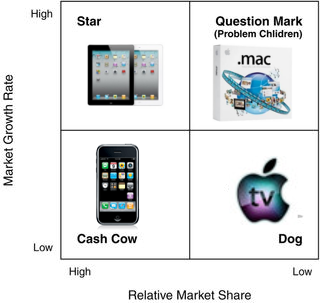
Star: This would be the iPad because it has a high share of the rapidly growing tablet market. As the iPad is in its growth phase of the product life-cycle, the product is beginning to lose its first-mover advantage as other manufacturers begin to launch theirown tablet devices. Hence, Apple should invest heavily into marketing the iPad in order to grow sales to maintain their share (sales need to grow at the same rate as overall market sales to maintain market share within a growing market). But in the future, when market sales become stable, Apple should harvest the product to turn it into a Cash Cow to fund other SBUs.
Question mark: Despite Apple’s best attempts, PCs with Microsoft operating systems still continue to dominate the PC market. Much of this is down to strong business-to-business marketing and high switching costs for businesses and consumers, alike. Apple could potentially used three strategies for their Mac software:
Question mark: Despite Apple’s best attempts, PCs with Microsoft operating systems still continue to dominate the PC market. Much of this is down to strong business-to-business marketing and high switching costs for businesses and consumers, alike. Apple could potentially used three strategies for their Mac software:
1) Divest – this could allow Apple to devote more time on their most profitable products, but it is highly unlikely as the Mac is part of the firm’s brand identity.
2) Build – Apple could potentially invest lots and lots of resources to try to turn Macs into a star, however even with Apple’s huge cash pile, it is questionable if it is even possible to beat Microsoft-powered PCs.
3) Hold – this is the most likely strategy. Apple will probably continue to develop new Macs and support existing customers, however investments will be kept at a minimum and be target towards the iPad.
Cash Cow: Apple’s source of steady flows of income are clearly the iPhone and the iPod; both the MP3 and mobile phone market have reached saturation and Apple has a high share of both these markets.
As the iPod is reaching the decline stage of the PLC, Apple is beginning to harvest the product. That is, slowly reducing investment in marketing iPods to increase their profitability; by generating more cash, further investments can be made into question marks or stars.
In the future, Apple will probably only maintain their market share of the iPhone. It is a highly profitable to generate sales from existing customers from upgrades, which can be almost guaranteed after a consumer invests heavily in downloads from the app store.
Dog: Lastly, Apple TV – a device that allows media files in iTunes to be played on a TV – has never really caught-on. By launching a second and third generation, Apple have shown they are committed to building sales. However, unless the overall market for digital media receiver grows, it could be more profitable to divest the product.

No comments:
Post a Comment